Showing posts with label Havencroft Farm. Show all posts

Tuesday, October 29, 2019

And the Seasons, They Go 'Round-an-'Round...


Buddha-cat keeps my neck warm these
frosty mornings
Fall Greetings from Havencroft Farm
 We are modern homesteaders, small holders, shepherds, and crafts people. We pay our electric bill, use the internet, drive our cars to our jobs, and store food in our refrigerator. But, we are still tied to the seasons  of the Earth. 
It's fall now, and we've had a few frosts. The garden is tucked in for the winter and the green tomatoes are sitting on the counter ripening for a few last summer-type dinners. The cats are looking for laps.
East Richwoods Nutmeg, our Alpine dairy
goat buck knows he's beautiful.
Fall is goat and sheep breeding season.
Having seasonal polyestrous animals
helps cement the cycle of the year.
It's sheep and goat breeding time. I breed the dairy goats first, so we have a supply of milk in case we have any bottle baby lambs or angora goat kids. Knock on wood, we won't, but best to be safe. At this point, the dairy goats are all confirmed bred and the breeding sheep are in with the rams. I got a new angora buck goat kid this year, Whisper Hills Oberon. He may or may not be ready to work, but he lives with the girls, and if they figure it out it's a bonus. Kid mohair is my favorite fiber.
Gibbs dog prefers to hang out in the
studio on now that mornings are cooler.

I spin and weave year-around, but I really seem to tuck into it in the fall. That's when I pull out my dyepots and make all the pretty colors for my yarns. We have our two annual shows in September and December, so much of my production schedule is geared around those.

My dad and my grandbaby Zo.


Now that we have a grandbaby in the family, it's another cue of the flow of life and the circle of time. I am luck to have both my parents and they dote on little Zo, who will not be little for long. Luckily human babies don't grow as fast as the sheep and goat kids!

In addition to farming, shepherding, spinning, weaving, and working full time, I am in the process of finishing out my bachelor's degree. I hope to graduate in May of 2020. One of the lesson I've learned is to be ok with my own schedule and my own cycle. My early 20's was my time to experience and explore, now is my time to put it all together into a formal credential. So, while I do seem to write more here in the winter (maybe it's because I'm inside more, or not at work quite as many hours!) it may be a while before I post regularly. In the meantime, if you've found our Havencroft Farm through this blog and are interested in the happenings here in the rural Ozarks, take a look at our Havencroft Farrm Facebook page. If you're looking for brooms or shawls or our other products, try our Havencroft Farm Etsy Store.

And, if you're just interested in a glimpse of our homesteading journey, scroll back through the archives here. Every once in a while I enjoy going back through this blog and remembering seasons past and the joy of the journey to today. Happy Fall 2019!

Harvest moon over the barn & good
brown dirt resting for the 2020 garden.

Wednesday, February 13, 2019

What to keep in your kidding or lambing kit

Havencroft Kachina had these adorable twin ewes by Havencroft Neptune. The new barn gives us a great set up for jug pens to give mom and babies a safe place to bond .
 It's the beginning of lambing and kidding time here in the Ozarks on Havencroft Farm. That means it's time to keep the "midwifery" kit hanging by the door so we're ready to help when needed.

I've been a shepherd since 1979. I learned from an old-time shepherd, Finley Nelson, and from my dad's stories of having goats when he was a kid. So, I do things the old fashioned way. I am happy to learn about new ways, but I still think simple is good.

Our lambing kit is simple. It starts with towels to help mama dry off babies. Most ewes or does have twins, so if we can help her by drying off one while she goes about the business of having the second, that's good. If it's cold, getting the babies dry quickly will help them stay warm.

Scissors, iodine, towels and clean straw are staples for planning on Havencroft Farm. 

The next thing that's in the kit is a sprayer bottle of iodine for spraying the lamb's umbilical cord. It's vitally important. We always iodine babies. Sometimes we dip navels, but for the last few years we've been drenching them well with the sprayer.

We also keep scissors in the bag, just in case we need to trim umbilicals that are dragging the ground, or trim wool away from udders on sheep that haven't been sheared yet. The next thing that is vital is making sure that babies nurse very soon after being born. They need the protection of the first milk, colostrum, to protect them from bacteria and to get their gut working. We check the mama's udder, making sure the colostrum is flowing freely even if we weren't there for the birth. We also check to make sure babies have full tummies and warm, moist mouths.

If the babies are too weak to nurse, or if there is any other reason they can't get colostrum within an hour of being born, we thaw out some frozen colostrum from last year, or earlier in the year and use a bottle or dose syringe to get it down them. We always freeze excess colostrum from our dairy goats in two ounce bags for just this purpose. Colostrum and soaking navels in iodine are considered absolutely necessary on our farm.

Something else I try to keep in the kit are recycled shopping bags. They are handy for disposing of after birth. We keep that cleaned up because we do have coyotes, raccoons and other predators that we don't want to invite with the smell of new birth.

We also make sure we have clean, dry bedding available. Some of our ewes choose not to use it, but we try.

Finally, we keep molasses in the kit. We mix about 2 tablespoons (or glugs)  in a bowl of warm water to offer to every new mom after giving birth. Most of them drink it down. It gives them water, sugar for energy and minerals like iron to help replace what they've lost.

It's not much, we keep it simple. We also do regular night time barn checks during kidding and lambing season. The whole flock gets used to the flashlight as the silly humans wander through their sleeping place two or three times a night. We are respectful of their sleep and try not to shine the light hard on any ewe or doe unless something looks unusual.

Saturday, April 19, 2014

Homesteading economics

"But don't you like meat?" queried the young woman as we talked about my goat flock. I had just given away the last of my crossbred goat kids to a family who raises them for their own winter meat supply. 
"Oh, I like our own farm-raised meat well enough." I replied. "Just not well enough to spend my milk supply raising meat."
I'd far rather have my milk for putting in my coffee, making cheese and sharing with my friends and family. Homestead economics. 

Monday, February 17, 2014

Shearing 2014 begins

Today was in the 50's with snow melt running off the hill and covering the ground with water. The long range forecast looks clement, so, we started started shearing. 

Ishmael was our bell wether angora goat. Having been sheared in late July, his fleece was more than ready. It is so full of winter hay, I'm not sure what I'm going to be able to do with it. 

I trimmed up Tillie's tummy and checked Fantasia, who is due March 1. I'll let her fleece grow a bit more. 

Moving over to the Jacob sheep, we sheared Nessie, who is due March 1. She has a udder the size of a jersey cow. We also sheared Higgs, who is due to have her first lambs in March. 


Ishmael putting up with his hair cut. He was very happy to go scratch and soak up sunshine when we let him off the stand. 

Monday, February 10, 2014

Havencroft Farm pic of the day


Nilly (Vanilla Bean), our 11-year-old Jacob sheep ewe, who was born blind, shares her breakfast with one of the silver-laced Wyandotte hens. 

Tuesday, December 10, 2013

Shepherd's Crook, our current favorite multi-use tool

Lena clears the ice off the horse & dairy goat shelter.
We are shepherds and one of the tools we learned to love, long, long ago, was a shepherd's crook. We tried several styles, but we find the old fashioned steam bent hickory is our favorite. You just can't leave it out in the weather or it will straighten back out.

We also love our portable shelters for our critters. They allow us to rotate grazing, to use deep litter bedding effectively and to manage our five acres sustainably. But we do have to be careful of snow loads on the hoop houses and tents.

This latest snow came down as ice, then wet snow, then more ice. Kind-of a creamy centered snow cookie effect. It is entertaining to walk on, but has been harder than heck to get off the road and a real challenge to remove from the shelters. We had our first hoop house flatten under the load with this snow. Boomer and his girls are all fine, and those hoop house panels will now be fence, once we get them out from under the snow.

We knew the first morning we had to get the snow off the dairy goat and horse's shared shelter. Shovels and brooms didn't work. Climbing up and tugging didn't work. Finally, we found the great multi-use tool that did the job - our good old shepherd's crook.

Stay safe and warm this winter, it's starting out challenging.

Sunday, December 08, 2013

Herkimer's Rug

Herki wants to know why I have
Fantasia's fleece on my head.
I've been raising colored angora goats since the mid-90's. I love the steel grays, soft oatmeal cream, and gentle brown colors. My goal was to breed a true, rich animal red doe. I have not achieved this goal, yet. 

About six years ago I had people start requesting white mohair rugs at shows. My response was that I don't breed white goats, so I can't make white rugs. Then I got my Tillie goat in a group of beautiful gray and black goats. Tillie is white. I so enjoyed dyeing and playing with the white mohair, and I am very, very fond of Tillie. She's the pretty goat on my business cards and posters. 

So, the next time I went looking for a buck, I bought a white one. Herkimer is a sweet boy. We named him after the Herkimer diamond because of his shiny white fleece. His offspring are all white, of course, and he is producing kids with a delightful variety of fleece textures. And, twice a year, he gets his hair cut and I can weave one white rug from his fleece. 

We shear all our fiber critters on a stand, using hand shears. Herki is a good boy for shearing, though he does like to tug on your clothes when he can reach them. We put each fleece in a pillow case as we shear and mark it with the animal's name, the date and the label "rug" or "spin" for the eventual process that the fleece will go through. Then we store all the fleeces on a big shelf in my shop.

Herki's fleece has beautiful locks that maintain their integrity through the weaving and felting process that each rug goes through. His is always labeled "rug" because it makes such beautiful ones.

The rug weaving process starts with considering the colors of fleeces I have and dyeing or finding the right 100% wool warp yarn for the fleeces. For this rug, I ordered several different "white" wool yarns to find the color I liked the best with his fleece. Then I measured out the warp yarns and tied them on the loom. Herki's rugs are pretty large and the weaving takes a while. 

Once I have woven the entire fleece into the warp, along with yarns to keep it stable, I take it off the loom and tie the fringes on each end. Then I start the felting process. Each rug gets its first bath in the tub, to get out the worst of the grime and begin the felting in the direction I want it to go. After rinsing well and drying for a bit on the porch rail, the rug then begins the machine washing and felting rounds. 

Locky and lovely, Herkimer's diamond rug.
I have a front load washer and each rug goes through about 7 cycles on the gentle wash with cold water. I am currently using Whisk detergent. It gets the rugs clean with our water. Most of the time, I dry the rugs on our porch railing, but when the weather does not permit, I dry them in the dryer on air dry.

This process gets each rug clean, and felts it slightly into a firm and durable rug. 
This fall's Herkimer rug is a unique treasure. It is definitely the most beautiful rug I've woven thus far. It was ordered during Studio Tour and its fond owner was going to pick it up at Christmas Showcase. Because of the storm, Showcase was cancelled, so I am making arrangements to mail this wonderful rug. 

You are welcome to visit Herki at the farm this year and see his kids. As we have a small flock, we usually only keep a buck or a ram for 3 years before finding him a new home and bringing in a new male with fresh genetics. Herki's rugs are so, so beautiful, I am tempted to keep him longer, but he is so good at his other job (making baby goats) that it will  be hard to keep him separate from his offspring. All that to say, Herki will probably only be here one more year. If you are interested in angora wether fiber goats, I have two Herki sons that will be looking for a new home next spring after shearing. And if you need a nice buck for your flock next October, let me know. I have a diamond of an angora goat buck who would love to find some new girls.

Sunday, November 03, 2013

Sweet potato harvest


This happened a few weeks ago, but life has been so busy, I haven't taken time to share here.


We keep an eye on the weather for frost warnings in October for many reasons. One is that we want to give the sweet potatoes as long as possible to grow, but still harvest them before the frost.
So, the second to the last Sunday in October, with frost imminent that week, we decided to break into the straw bale garden. I called my dad to see if he wanted to join us. Their house is 15 minutes away from our farm. 
The kids went out to start the harvest. By the time I got out there, they were finishing up. My dad arrived in time to help them put the harvested sweet potatoes on feed sacks on the bed of the truck to dry. Easiest sweet potato harvest ever!

Good big potatoes from our own slips from last years potatoes.
The sunny side of the straw bale potatoes patch produced much bigger potatoes than the more shaded side. Something to remember for next years garden.

This is how I'm growing all our root vegis from now on!

Arjuna lifted the mat of sweet potato vines and broke open the straw bales beneath.

Love this one.


Robin's flatbed truck makes a good sweet potato drying bed.


One of the big ones. 1.5 pounds


Bigs and littles. My favorites are the fat ones.

Sunday, August 11, 2013

Duck soup delights

This is not a post about supper or recipes. It is about the wonderful wet weather we've been having. There is water just laying all over the ground. More of that precious resource falls from the sky every day. I wish we had better ways to store this abundance for times of shortage, but for now, we'll just appreciate it. 


The sheep are enjoying their pasture between storms. We are checking the frequently for parasite issues. 


The figs, tomatoes and other fruits are splitting their skins from the abundance of water. 


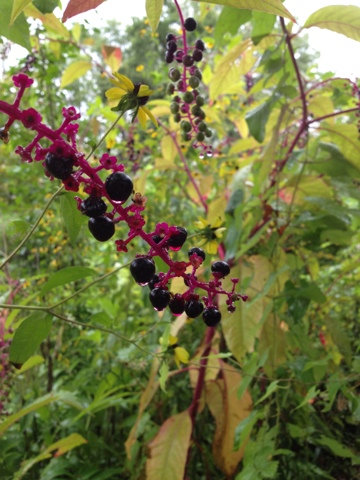
The rain is dripping pink off the poke berries. 

Sunday, August 04, 2013

Color inspirations

Where do I get my inspiration for my color combinations?
Join me for a rainy morning walk in the garden. 


The world is so gorgeously green this morning. I think Oz is just short for Ozarks and we live in the Emerald City. 

Tuesday, July 30, 2013

Birdsong and painted skeins

A new batch of painted handspun Jacob sheep wool yarn in the predawn blue light

The bird and insect symphony was so rich in this morning's predawn blue light, as I was hanging newly painted skeins of yarn out to dry. I wished I could share the whole experience with everyone. But even if I had video'd it, the richness of the morning air, the deep blueness of the light and the unique harmonies of the morning chorus would not have come through.

So, just grab a cuppa your favorite morning beverage, (mine is Dean's Beans Mocha Sumatra coffee, cold with goat's milk) take a deep breath and imagine sharing this beautiful blue morning here on Havencroft farm.

Have a delicious day.


Monday, July 29, 2013

Dipping our toes back in the show waters

I love showing livestock. Ever since I fitted and showed my first Brown Swiss dairy heifer Catalpa, as part of a class at Colorado State University, I've loved showing livestock. I love the fitting and preparing. I love seeing all the other breeds and breeders and animals in my chosen breed. I love the excitement of watching everyone get ready. But mostly love being in the class and hearing the judge give the reasons for his placings.It's an adrenaline charged way to learn good, better, best in your chosen animals.

National Western Stock Show in Denver has always been one of my favorite places to show and in 2006 the centennial year of the show, we took Grand Champion Farm Flock in the natural colored sheep division with our Jacob Sheep. That banner hangs on my wall to this day, along with several other grand champion and reserves and some pretty blue firsts.

Then we moved here to the Ozarks and had a lot of other things on our plate. But, next month, the Jacob Sheep Breeders Association is having it's Annual meeting and sheep and fleece judging in Sedalia, Missouri, only 4 hours from our farm and WE"RE GOING!
Hester getting her haircut.

I'm taking three little ewes to show. Two yearlings Hanna and Hester and this year's little Iko. That's two Canoe Lake Sonic Boom daughters and one Havencroft Dapper Dan daughter. They'll have registry inspections there, so I hope to catch up on my registrations, something else that has fallen through the cracks.

I'm donating this Corriander vest to the fundraising auction. We're figuring travel plans and packing lists and ... The show is Labor Day Weekend, just a month a way. Shawn and I are getting to go together. Yippee!